
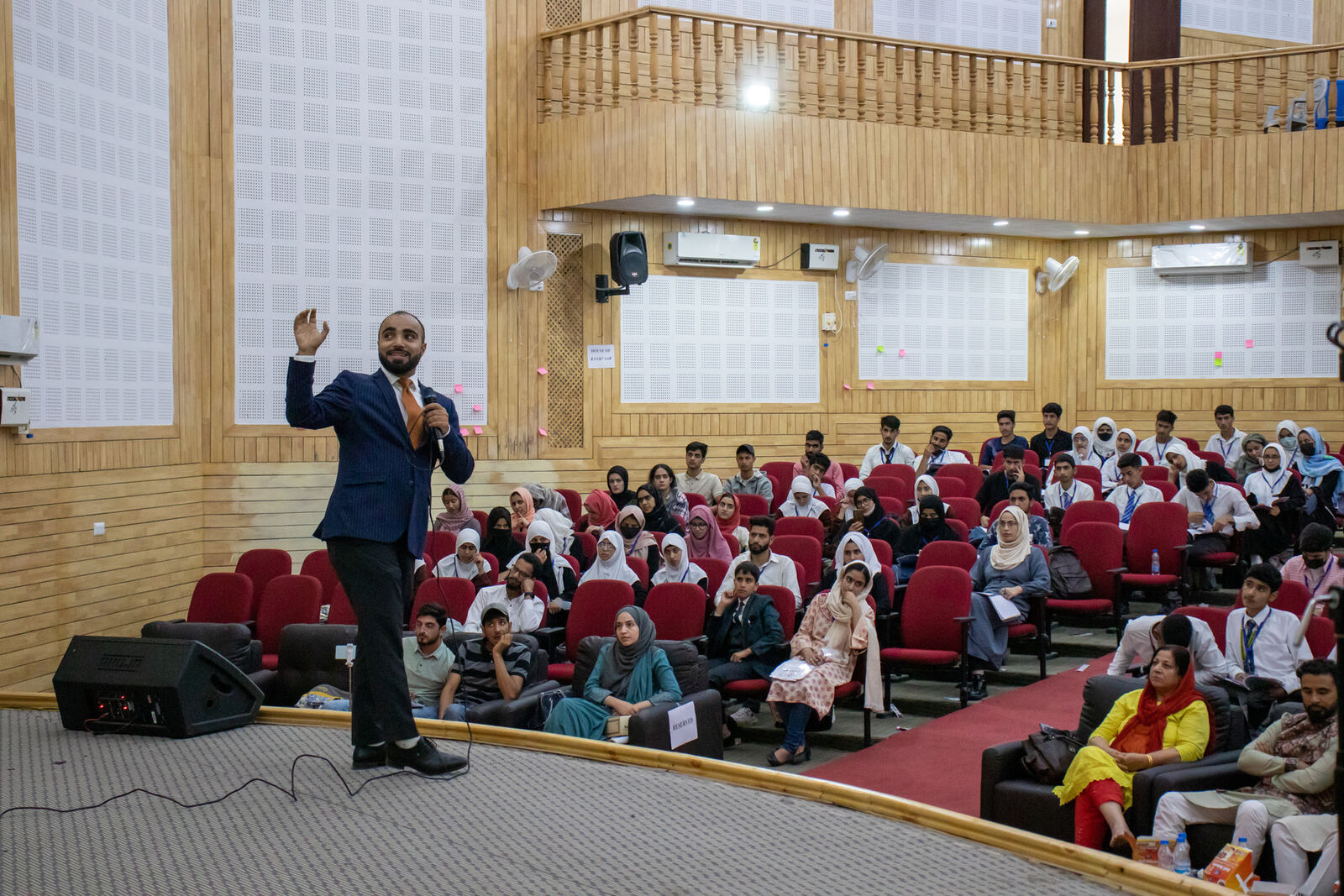
Before you have finished your first few sentences, your audience has already made a decision. Not about whether you are right, but about whether you are worth listening to.
That is not unfair. It is human. Attention is precious, and people protect it. Your opening is where you earn it.
Three openings to avoid
1. The apology. "I'm not a great speaker, so please bear with me." You have just asked the audience to expect less. They will.
2. The long thank-you list. Thanking the organisers is gracious. Thanking eleven people by name before saying anything meaningful drains the room. Keep it to one warm sentence, or move it to the end.
3. The definition. "According to the dictionary, leadership is..." The audience has heard this a hundred times. Their phones are coming out.
Five openings that work
1. Start with a moment. Drop the audience into a scene. "It was 6am, the snow was still falling, and I was standing outside a school that had no heating." Stories open ears.
2. Ask a real question. Not a rhetorical one, but one that makes people think about their own lives. "When was the last time you changed your mind about something important?"
3. Make a bold statement. "Motivation does not last." A surprising claim creates tension the audience wants resolved.
4. Share a striking fact. A specific, surprising, verified number can wake a room. Make sure it is true and you know where it came from.
5. Show something. An object, an image, a gesture. Holding up a single chinar leaf before you speak about change says more than a paragraph.
Then, the bridge
After the opening, you need a bridge to your message. One or two sentences that say: here is why this matters to you, and here is what we will explore. Then you begin.
Your opening is a promise. The rest of your talk is how you keep it.
Openings for different occasions
The right opening depends on the room. Here is how I adapt.
At a convocation or student event. Young audiences respond to stories and directness. Begin with a moment from your own student life, or a question about their future: "Five years from now, what will you wish you had started today?"
At a corporate training. Professionals are busy and sceptical. Lead with relevance: a problem they recognise, stated precisely. "Most of the meetings in this building end without a clear decision. Today I want to change that."
At a community gathering. Warmth matters most. A shared memory, a local reference, a proverb. In Kashmir, a well-chosen line from our poets can open hearts faster than any statistic.
At a conference panel. You may have only a few minutes. Skip the warm-up entirely. State your most important idea in the first sentence.
What your opening says about you
An opening does two jobs. It introduces your topic, and it introduces you. In those first moments, the audience is asking: is this person prepared? Do they respect our time? Will this be worth it?
A crisp, confident opening answers yes to all three. It tells the room that you have thought carefully about them. That is a form of respect, and audiences return it with attention.
When your opening goes wrong
Sometimes, despite all your preparation, the opening falls flat. The joke does not land. The microphone fails. You forget your first line.
Pause. Breathe. Smile, if it fits. Then simply begin again, or move to your next point. Audiences are far more forgiving than we imagine, and they deeply admire a speaker who recovers calmly. A calm, honest recovery, with a little humour if it fits, often builds more connection than a flawless start.
Practise the opening most
If you rehearse anything, rehearse the first 30 seconds until you could say them half asleep. Nerves are highest at the start. A memorised opening carries you through them, and by the time it ends, you are warmed up.