Every spring in Kashmir, the almond trees in Badamwari flower for a few short weeks. People travel from across the valley to stand under them. They take photographs, they walk slowly, they speak more softly than usual. And then the blossoms fall, and most of us go back to walking past the same trees without looking up.
I have been thinking about that for a long time. Not the blossoms themselves, but the way we wait for permission to notice. We save our attention for the spectacular and spend the rest of our lives on autopilot.
Bloomseeing is my answer to that habit.
A simple definition
Bloomseeing is the practice of noticing what is already here. It is attention, trained gently and on purpose, towards the life you are already living: the light on a wall, the voice of someone you love, the small courage it took to get out of bed today.
It is not positive thinking. It does not ask you to pretend that hard things are easy. It asks something more modest and, I think, more powerful: that you see clearly. When you see clearly, you see the difficulty, and you also see what is still growing beside it.
Your life is blooming. The only question is whether you are there for it.
Why attention matters so much
What we pay attention to becomes the texture of our days. Two people can live through the same week, with the same work and the same weather, and describe two completely different lives. One remembers the traffic and the deadline. The other remembers the deadline too, but also the cup of noon chai a colleague brought without being asked, and the way the evening sky turned the colour of saffron over the Zabarwan hills.
The second person is not luckier. They are practising, whether they know it or not.
I call it informed attention. Informed, because it is not vague mindfulness floating above life. It is grounded. You know what you are looking for, you know why, and you return to it every day the way you return to a well.
The three movements of Bloomseeing
When I teach Bloomseeing in workshops and in coaching, I break it into three simple movements.
- Pause. Stop long enough for your attention to arrive. Three breaths is often enough.
- Notice. Choose one thing and look at it as if for the first time. Name three details you would usually miss.
- Receive. Let it matter. Ask yourself what this small thing is telling you about your life right now.
That is all. It takes about three minutes. And yet when people do it every day for a few weeks, something shifts. They tell me they feel calmer. They feel less hurried inside, even when life outside stays busy. Some of them tell me they feel like they have come home to their own lives.
What Bloomseeing is not
Because the word sounds gentle, people sometimes assume the practice is soft. It is not. It takes discipline to look closely at a life that is not going the way you planned. It takes courage to notice beauty in a season of grief without feeling guilty for it.
Bloomseeing is also not a way of escaping problems. In coaching, I use it as the starting point for change. You cannot change a pattern you cannot see. Attention comes first; action follows.
Bloomseeing in ordinary life
It helps to see what this looks like on an ordinary day, because Bloomseeing is not something you do on a mountain top. It is something you do between meetings, on the school run, in the kitchen.
Picture a teacher who begins practising on her walk from the bus stop to her school. The same lane, every morning, for eleven years. She stopped seeing it long ago. When she begins to look, she finds a vine climbing a broken wall, a shopkeeper who greeted every child by name, a particular blue door she had never noticed. Nothing about the lane has changed. She has.
Or picture a young engineer who practises in the most unlikely place: traffic. Instead of gripping the wheel and scrolling at red lights, he notices one thing each time. The light on a building. A family on a scooter, the youngest asleep against her father's back. The commute, of all things, becomes the calmest part of his day.
None of this is dramatic. That is the point. Bloomseeing is the quiet art of making the ordinary visible again.
Why I call it Bloomseeing
I chose the word carefully. "Bloom" because growth is always happening, in nature and in people, often slowly and out of sight. "Seeing" because the practice is not about making things bloom. They are already blooming. It is about seeing it.
There is relief in that idea. Many of us carry an exhausting belief that nothing good will happen unless we force it. Bloomseeing suggests another way. Some of what you are waiting for is already here. Your work is to notice it, nurture it and let it matter.
Bloomseeing and change
People sometimes worry that a practice of noticing will make them passive. If I am busy appreciating what is here, will I stop trying to improve my life?
In my experience, the opposite happens. When people begin to see clearly, they also see what needs to change, without the fog of panic or shame. They notice which relationships nourish them and which drain them. They notice which habits leave them alive and which leave them empty. Clear seeing leads to wise action.
This is why Bloomseeing sits at the heart of my coaching. Before we set goals or change habits, we look. Honestly, gently, completely. Change built on clear sight lasts longer than change built on frustration.
Where to begin
If you want to begin today, you need nothing but three minutes and an honest eye.
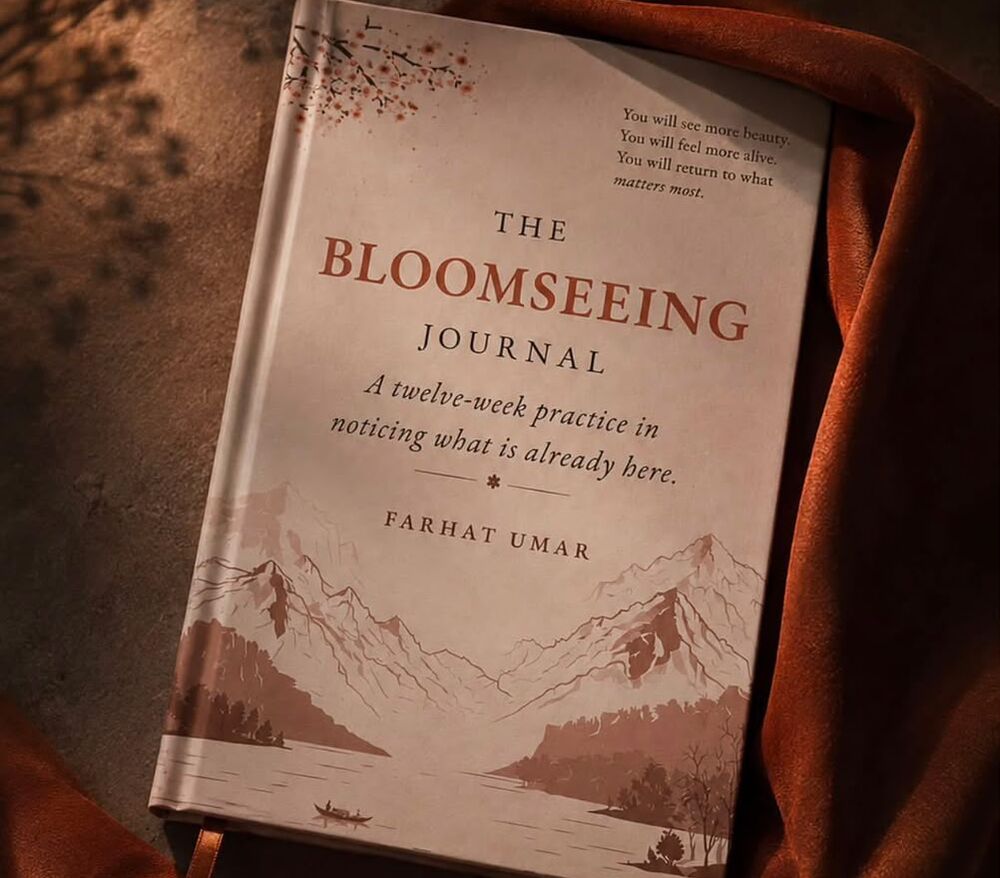
This is where The Bloomseeing Journal began, and it is where every conversation I have about a fuller life begins too. Not with more. With noticing what is already here.